

Autism Therapies for Children: A Simple Guide to Occupational, Speech, Music and Colour Approaches
When a child is first diagnosed on the autism spectrum, most parents feel a mix of worry, confusion and urgent questions about what to do next. You hear about different autism therapies for children, but it is hard to know which ones are useful, which are suitable for your child’s age, and how they actually look in real life – in school, at home and in therapy rooms.
For families in and around Erode, these decisions are even more practical: you want support that fits your child, your budget and your daily routine, not something that only exists in big cities. That is where a simple guide to occupational, speech, music and colour-based approaches can help. These are some of the most commonly used autism therapies for children, and they can be combined to support communication, behaviour, learning and daily living skills.
This article starts with the basics of what autism is, then explains how four key therapies work:
- Occupational therapy for everyday skills and sensory needs
- Speech therapy for language and communication
- Music therapy to support calm, connection and expression
- Colour-based approaches to shape the environment and sensory experience
By the end, you will understand how these therapies fit together, what to expect in sessions, and how parents and the local community can practically support autistic children in Erode and similar areas using the right autism therapies for children at the right time.
What Is Autism? A Simple Explanation for Parents
Autism, often called autism spectrum disorder (ASD), is a developmental difference in how a child’s brain processes information, communicates and experiences the world. It is not a disease and not something caused by parenting style; it is a different way of thinking and sensing that begins in early childhood and continues throughout life.
Most autistic children show differences in three main areas:
1. Communication and language
- May talk later than other children or use fewer words
- May repeat words or phrases (echolalia) instead of using them flexibly
- May find it hard to understand questions or follow multi-step instructions
2. Social interaction
- May prefer to play alone or find group activities tiring
- May avoid or find it hard to maintain eye contact
- May struggle with back-and-forth conversation, sharing and turn-taking
3. Behaviour, interests and sensory responses
- May have strong routines and get upset by small changes
- May repeat movements like hand-flapping, rocking or spinning (stimming)
- May be very sensitive or less sensitive to sounds, lights, touch, smells or textures
These signs can appear differently from child to child. Some children speak well but struggle socially; others may use few or no words but show strong understanding in other ways. What they all need is understanding, respect and the right autism therapies for children to support communication, learning and independence over time.

What Is Occupational Therapy for Autism? A Simple Guide to How It Helps Children
Occupational therapy (OT) for autism focuses on the everyday “jobs” of a child – playing, learning, moving, dressing, eating and managing basic self-care. For many families exploring autism therapies for children, OT is often one of the first referrals because it addresses both the body and the brain together. Children on the spectrum may have challenges with balance, posture, fine-motor skills, sensory processing and planning movements. OT breaks these big challenges into small, achievable steps.
Background and core ideas in OT
Occupational therapists look at:
- How a child sits, holds a pencil, uses their hands
- How they react to sound, touch, movement and light
- How they manage simple routines like brushing, eating, dressing
They then design structured activities that:
- Strengthen muscles and improve posture
- Build hand-eye coordination and fine-motor control
- Help the child tolerate or organise sensory input (noise, touch, movement)
This is why OT is often listed among the best therapies for autism when it comes to daily living skills and school readiness.
Practical OT activities in school and therapy settings
In a special school or early-intervention centre, OT can happen in:
- A dedicated therapy room with swings, balls, ramps and sensory tools
- The classroom, where the therapist coaches teachers on simple adaptations
- Group sessions, where children practise waiting, sharing and turn-taking
Common OT activities include:
- Obstacle courses for balance and planning
- Peg boards, threading and puzzles for fine-motor skills
- Brushing, deep-pressure and movement input for sensory regulation
When combined with other types of therapy for autism in children, OT helps children sit better, focus longer and participate more actively in class and at home.
Common mistakes parents make with OT
1. Expecting instant results
- OT builds skills slowly; expecting big changes in a few weeks leads to frustration.
2. Using therapy only at the centre
- Not carrying simple OT ideas into daily routines (getting dressed, eating, bath time) limits progress.
3. Comparing children
- Each child’s sensory and motor profile is different; progress will not match another child’s timeline.
4. Over-focusing on handwriting
- Parents may push pencil skills too early instead of first building posture, grip strength and shoulder stability.
5. Ignoring the child’s sensory needs
- Forcing a child into noisy or bright places without OT strategies can undo gains made in sessions.
Technology and strategy in modern OT
Today, OT may include simple apps, visual schedules on tablets, computer-based games for hand-eye coordination, and even digital timers to help the child understand “how long” an activity will last. For families exploring autism therapies for children in Erode, this can mean a mix of traditional hands-on work and basic digital tools that make routines clearer and more predictable.
What Is Music Therapy for Autism? How Sound Helps with Calm and Communication
Music therapy uses rhythm, melody and sound to support emotional regulation, social connection and sometimes speech. Many parents notice that their child reacts strongly to music – they may hum the same tune, tap out rhythms or calm down with particular songs. This natural attraction can be used inside structured autism therapies for children to open doors that may be difficult through words alone.
How music therapy works for autistic children
Music therapists design sessions that:
- Use steady rhythm to help children regulate their bodies
- Use singing and turn-taking songs to build joint attention
- Pair simple words or phrases with tunes and actions
- Offer safe ways to express emotions through voice or instrument play
While research is still growing, music-based work is often mentioned alongside other types of therapy for autism in children because it can support engagement, focus and emotional balance.
Practical uses in classrooms and therapy rooms
In a special school or early-intervention centre, music can be:
- A group circle-time with action songs and greetings
- A one-to-one session focusing on vocalisation, imitation or turn-taking
- A calming ritual at the start or end of the day
Examples:
- Using a hello song where each child’s name is sung, encouraging eye contact and response
- Drumming games that require “my turn / your turn” to practise waiting
- Simple melodic phrases paired with daily instructions like “sit down”, “stand up”, “pack bag”
This kind of work can support and amplify the best therapies for autism, such as speech and occupational therapy, by increasing attention and emotional readiness.
Mistakes to avoid with music therapy
1. Treating it like entertainment only
- Unstructured music all the time is not the same as targeted music therapy.
2. Over-stimulating with loud sound
- High volume or complex music can overwhelm children who are sound-sensitive.
3. Expecting speech to appear suddenly
- Music may open pathways, but speech often improves slowly, especially when paired with formal speech therapy.
4. Ignoring the child’s preferences
- Forcing songs a child dislikes can cause more resistance than progress.
5. Using screens for all music
- Live, interactive music with a therapist or teacher is usually more effective than passive video watching.

Technology and tools in music-based approaches
Simple speakers, keyboards, basic percussion instruments and recorded tracks can support sessions. Apps that allow children to trigger sounds with touch can engage those who enjoy cause-and-effect play. In many blended autism therapies for children, music is used as a bridge – to transition between activities, calm a group, or prepare children for speech and movement tasks.
Read our detailed blog about What Is Music Therapy for Autism? How Sound Helps with Calm and Communication to understand more about this topic.
What Is Colour Therapy for Autism? Benefits, Techniques and How It Really Works
Colour-based approaches for autism are not a replacement for core autism therapies for children, but they can play a helpful role, especially for sensory regulation and creating calm environments. Children on the spectrum can be more sensitive to visual input. Bright lights, harsh contrasts and cluttered spaces may make it harder for them to relax or focus, while certain shades and gentle lighting can support attention and comfort.
Background: colours, sensory processing and autism
Research and practice suggest that:
- Some autistic children prefer softer, pastel or muted shades rather than very bright tones
- Overly strong colours (for example, very bright red in large areas) can feel overstimulating
- Balanced, low-clutter environments often help children feel safer and more organised
When families think about the types of therapy for autism in children, they rarely think of wall colours or classroom design, but these factors quietly support the more formal therapies like OT and speech.
Practical applications: rooms, materials and routines
Colour-based ideas can be applied in:
- Sensory corners with soft blues, greens or neutral shades
- Clear visual schedules using colour coding (one colour for home, another for school activities)
- Calm spaces where children can retreat when overwhelmed
Examples:
- Using a soft-coloured mat for “calm time” and a brighter mat for “play time” to signal different expectations
- Keeping classroom walls less cluttered and using limited colour accents for key information
- Choosing gentle lighting instead of harsh glare that can bother visually sensitive children
When used thoughtfully alongside the best therapies for autism, colour and design can reduce stress so children can make better use of OT, speech and classroom teaching.
Common mistakes with colour-based approaches
1. Painting rooms in very bright, intense colours everywhere
- This may excite rather than calm, making attention harder.
2. Changing colours too often
- Frequent shifts in room look can disturb children who rely on sameness.
3. Using colour without structure
- If colour coding is used, it should be consistent across schedules, labels and routines.
4. Expecting colour alone to “treat” autism
- Colour is a support tool, not a standalone therapy.
5. Ignoring the child’s individual response
- Some children may like a shade that others dislike; observation is essential.
Technology and visual tools
Digital tools like visual schedule apps, coloured timers and simple on-screen symbols can extend colour-based supports into daily life. For families exploring autism therapies for children, colour can be seen as part of the environment design that makes every other therapy easier to access.
What Is Speech Therapy for Autism in Children? How It Improves Communication
Speech-language therapy is one of the most widely known autism therapies for children because communication differences are a core feature of autism. Children may speak late, speak only in single words, echo others, or struggle with back-and-forth conversation and social language. Speech therapists assess each child’s current level and plan strategies to build understanding and expression.
Key goals of speech therapy
Speech therapy for autistic children often aims to:
- Improve understanding of words, instructions and questions
- Build expressive skills – sounds, words, sentences and stories
- Support non-verbal communication like gestures, pointing and eye-gaze
- Develop social communication – greeting, taking turns, staying on topic
This is why it is always listed among the central types of therapy for autism in children in medical and educational guidelines.
How speech therapy looks in practice
Sessions may include:
- Picture-based activities to teach vocabulary and sentence building
- Play-based interaction for younger children, focusing on joint attention
- Role-plays and conversation practice for older children
- Support for alternative communication, such as picture exchange or simple communication devices when needed
In school settings, therapists may work closely with teachers so that strategies are carried into classroom routines, making speech therapy one of the best therapies for autism when it is embedded in daily life, not kept only in a therapy room.
Common mistakes around speech therapy
1. Focusing only on talking
- Understanding and non-verbal cues are equally important; speech is more than words.
2. Switching therapists too often
- Constant change can slow progress; some stability helps children feel safe.
3. Expecting all progress to show in “big” words
- Small gains like better eye contact, more pointing or following instructions are significant.
4. Ignoring home practice
- Simple daily games suggested by the therapist can multiply the effect of sessions.
5. Comparing siblings or peers
- Each child’s communication path is unique; comparing can create pressure and disappointment.
Technology and modern tools in speech therapy
Today, many speech programs use picture apps, simple text-to-speech tools, and tablet-based communication boards. When used carefully, these support autism therapies for children by giving them a way to express needs and choices even before full speech develops, which can reduce frustration and behaviour issues.
Putting It All Together: Choosing and Combining Therapies
When parents first hear about so many types of therapy for autism in children, they may feel they must do everything at once. In reality, the most effective plans usually start with a few key priorities based on the child’s age, strengths and challenges, and then build from there. OT may focus on sensory and motor foundations, speech therapy on communication, music on engagement, and colour-based work on creating a friendly environment.
A balanced plan might look like:
- Early years (0–6): focus on early-intervention programs combining OT, speech, sensory play and parent training
- School years: integration of therapies into classroom routines, special school support where needed
- Ongoing: periodic review of what remains among the best therapies for autism for that child at that stage – not just what is popular or trending online
Parents in and around Erode can look for centres and schools that:
- Offer multiple therapies under one coordinated team
- Share clear progress updates and simple home-practice ideas
- Respect the child’s pace and personality, not just test scores
When these conditions are in place, autism therapies for children are more likely to translate into real changes in daily life – eating better, sleeping better, joining in play, communicating needs and slowly growing in independence.
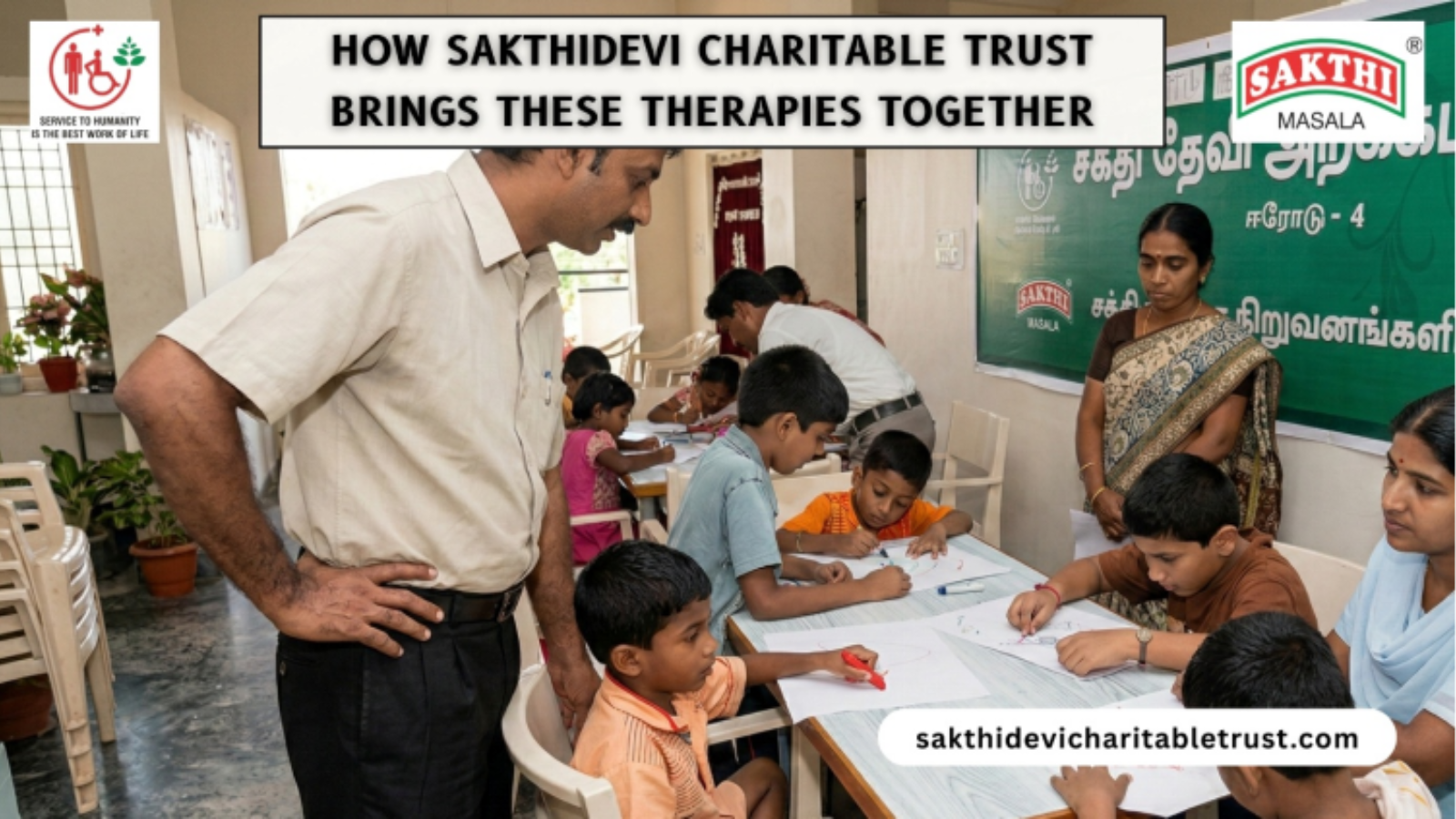
How Sakthidevi Charitable Trust Brings These Therapies Together
For families in Erode and nearby areas, Sakthidevi Charitable Trust brings many of these supports under one umbrella through its special schools, autism schools, early-intervention centre and rehabilitation services. Children can receive occupational-style activities, sensory work, music-based learning and speech training within a structured school environment, rather than running between many separate providers. Parents receive counselling, guidance and regular updates so they can continue autism therapies for children in daily life at home.
If you are looking for practical, child-friendly and values-driven support, you can explore the services described on the Sakthidevi Charitable Trust website and see how their team in Erode supports special education, early intervention and long-term rehabilitation as part of a single, caring system.
Frequently Asked Questions
- How do I know which autism therapies for children to start with?
Most families begin with an assessment from a paediatrician or child specialist, followed by referrals to OT and speech therapy based on the child’s needs. For some children, sensory or behaviour concerns may be a priority; for others, language delay comes first. The key is to choose a small set of autism therapies for children that address the most important daily challenges and then review progress every few months. - Can music and colour approaches replace other types of therapy for autism in children?
No. Music and colour-based techniques are best seen as supportive approaches that make environments calmer and sessions more engaging. They work well alongside core types of therapy for autism in children such as occupational, speech and behavioural interventions, but they do not replace them. When integrated into a larger plan, they can help children regulate, focus and participate more fully. - How long do the best therapies for autism usually take to show results?
There is no fixed timeline. Some children show small changes within weeks, such as better eye contact or smoother routines; larger gains in communication, learning or behaviour can take months or years. The best therapies for autism are those that are consistent, child-centred and sustainable for the family, rather than those that promise quick miracles. Regular review with the therapy team helps you see subtle progress over time. - Are autism therapies for children effective if started after age six?
Yes, children can benefit at any age, though early start often gives more time for practice and neural development. After six, goals may shift more towards classroom participation, social communication and independence. It is still worthwhile to begin autism therapies for children later, especially when school or family life is clearly affected. - How can parents in and around Erode access these therapies in one place?
In and around Erode, some organisations provide combined services, including special schools with integrated therapy rooms and rehabilitation centres. At such places, families can access OT-style activities, speech input, sensory work and structured learning under one team, which often reduces confusion and travel stress. Exploring local centres that follow this model can make autism therapies for children more manageable for both parents and children.
 ADDRESS
  Phone Number
 EMAIL ID
Leave a Reply