
Role of Teachers in Rural Education: Practical Strategies to Improve Government Schools
Rural classrooms are often the first formal learning space a child ever sees, which makes the role of teachers in rural education deeply personal and powerful. A single encouraging teacher can turn a shy village student into a confident learner who believes that school is “for me” and not just for city children. In government schools, teachers are not only subject experts; they are mentors, counsellors and connection points between families, communities and the education system. When they are supported with the right skills and tools, the impact ripples through the entire village.
Teachers as the Heart of Rural Classrooms
In many villages, the teacher is the most educated person the child regularly meets. This means:
- Children copy their way of speaking, thinking and behaving
- Parents judge the value of school based on how the teacher engages
- Communities trust or doubt the system based on teachers’ actions
When we talk about the role of teachers in rural education development in erode, we are really talking about how learning feels inside the classroom: safe or scary, active or dull, hopeful or hopeless.
Practical Classroom Strategies That Work
To keep lessons meaningful and simple, teachers can:
- Use local examples (farm, shop, bus stand) to explain maths and science
- Ask more questions instead of only giving answers
- Mix board writing with group work and pair discussions
- Give short, regular feedback instead of waiting for term-end exams
These small habits go a long way in improving teaching quality in government schools, even when resources are limited.
Why Teacher Training Matters in Rural India
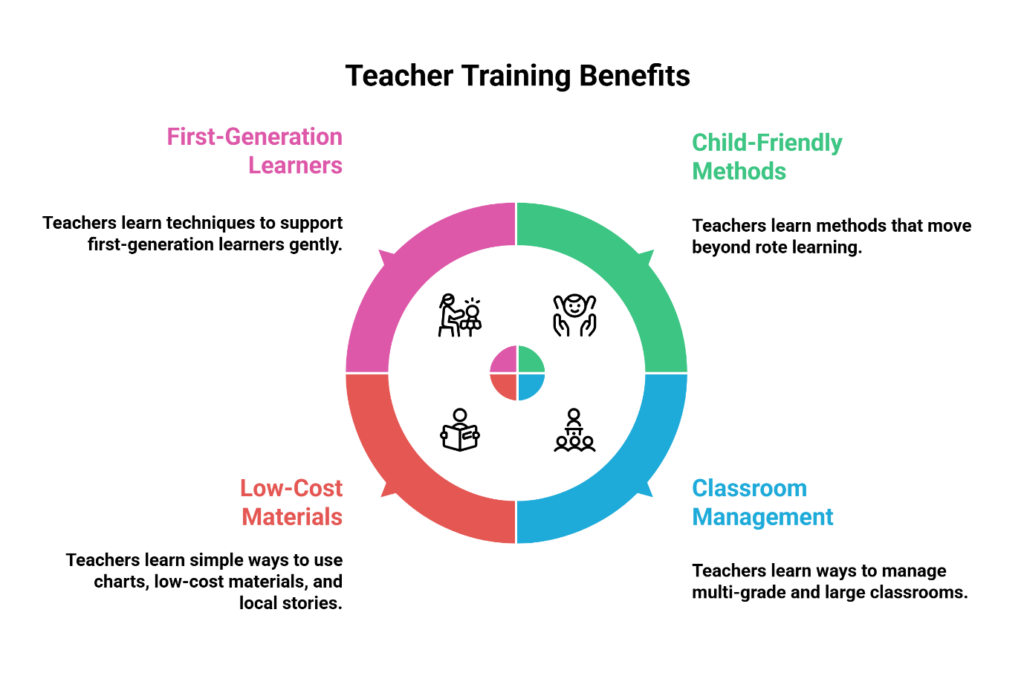
Strong intentions alone are not enough; skills must be updated. Well-planned teacher training in rural India helps teachers learn:
- Child-friendly methods that move beyond rote learning
- Ways to manage multi-grade and large classrooms
- Simple ways to use charts, low-cost materials and local stories
- Techniques to support first-generation learners gently
When such training is continuous and practical, the role of teachers in rural education becomes easier to handle and more effective for students.
Building a Supportive Ecosystem Around Teachers
Teachers work best when they are not alone. Support can come from:
- School heads who protect teaching time and reduce unnecessary tasks
- Peer sharing circles where teachers exchange ideas and lesson plans
- NGOs and trusts that offer focused workshops and classroom resources
You can explore this in detail in our guide on how NGOs for rural education in Erode improve government schools, which explains the systems they use to strengthen learning in rural areas.
Together, these efforts create a culture of improving teaching quality in government schools, rather than leaving each teacher to struggle on their own.
How Sakthidevi Charitable Trust Supports Teachers and Students
In and around Erode, Sakthidevi Charitable Trust quietly strengthens the role of teachers in rural education by making their work easier and more meaningful. Through its Vazhikatti program, the Trust sets up libraries, conducts competitions, organises summer skill camps and provides extra coaching support in government schools, so teachers get more space to focus on real teaching rather than only arrangements. Its higher-education and special-education services also ensure that rural students, including those with special needs, have pathways beyond school, which further motivates teachers to invest in every child’s progress.

Leave a Reply